Can We Abolish Debt?
This article is an adaptation of a video I originally published on my YouTube channel.
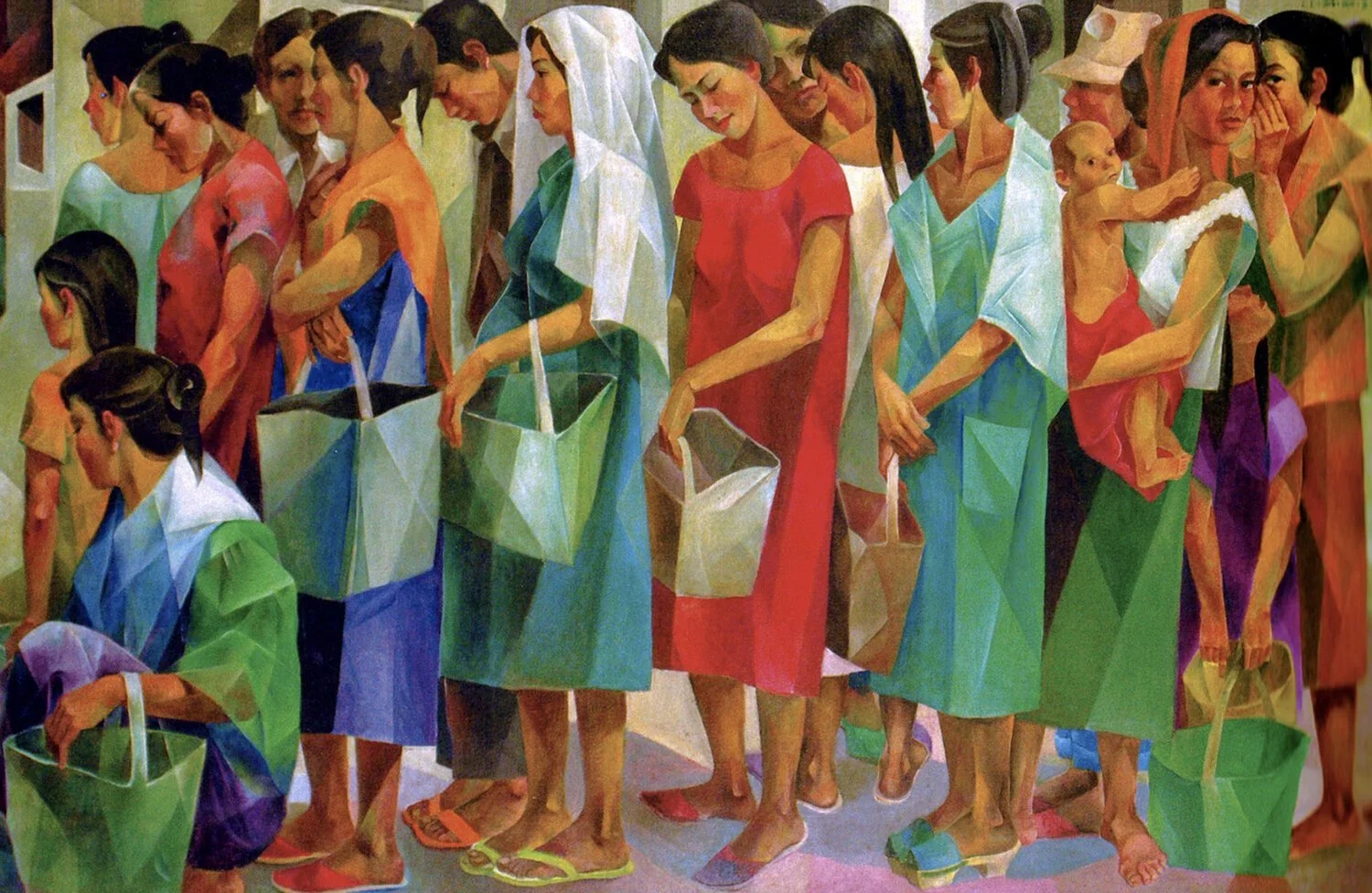
Art by Vincente Manansala
Our world suffers from a crisis of debt.
Millions live paycheck to paycheck, shackled by loans they can never fully escape. Entire countries spend decades in debt while barely making progress on the principal. Whether we’re talking about the persistent strain of student loans, the decades-long bondage of a mortgage, or the imperialist impositions of the IMF, debt weighs heavily upon the course of our personal and societal histories. There’s no amount of not eating avocado toast that will undo that burden.
To some, the issue of debt is quite straightforward: you borrow, you pay back. Always. No ifs, ands, or buts. No interrogation of power dynamics. No further context necessary. It is a moral imperative, simple as, regardless of the outcome for the person or the society at large.
I’m not satisfied by that cold simplicity. I’ve seen the devastation of families, communities, and entire countries resulting from that “moral” imperative. I’ve seen victims of colonialism and capitalism blamed for their oppression because of debt. And if the blatant double standard of elites being bailed out while common people suffer didn’t make it clear, let me spell it out for you: debts don’t always have to be repaid. The idea that they do is selectively used to keep the poor struggling and the powerful in charge.
The late anthropologist David Graeber deeply understood the same. As he put it, “If history shows anything, it is that there’s no better way to justify relations founded on violence, to make such relations seem moral, than by reframing them in the language of debt—above all, because it immediately makes it seem that it’s the victim who’s doing something wrong.1”
Over 500 pages, Graeber explored the concept in Debt: The First 5000 Years (2011). It’s now fairly well-known, and on the to-read lists of many, but I consider the ideas in his book far too valuable to be limited to one medium. I still recommend reading it yourself, but this work exists to explore its key ideas and go further. By taking a critical look at Graeber’s exploration of debt and its role in shaping our systems and relationships, we can challenge our approach to debt, overcome the current crisis, and pursue a revolutionary reimagining of the economy as a whole.
Debt & The Origins of Money
Perhaps we should start by asking what debt is. According to the Cambridge Dictionary, debt is something, especially money, that is owed to someone else. The word itself comes from the Latin debere, meaning owe. At its core, we could say that debt is a question of what we owe to each other. As Graeber’s argument goes, early economies were built on unquantified mutual obligations, rather than precisely measured credits and debts. So the difference between obligation and debt is quantification. To paraphrase reviewer Joseph Kay, it’s the difference between, “Thanks man, I owe you one” and “Thank you, I owe you a dollar.” Our mutual obligations created flexible, ongoing social bonds that composed what might be called gift economies.
Contrary to the common economic parable of money evolving from barter2, money originated as a system for tracking and managing our social obligations with greater precision and clarity. It’s kind of like having metres and centimetres to measure length. Money usually has four functions, identified by English economist William Stanley Jevons:
a medium of exchange,
a unit of account,
a store of value,
and a standard of deferred payment.
We use money to get the things we want, to measure the value of things, to save value long-term, and to keep track of what we owe.
Money has historically taken two forms: as credit and as commodity. Credit is essentially an IOU—it’s a promise of future value rather than something of inherent worth on its own. As a promise, it requires trust, both in each other and in the issuer of that credit, whether it’s a state, a person, or a community. We don’t accept cash or credit because some paper or numbers on a computer are valuable in themselves, we accept them because we trust that others will accept them in the future to get things that we do value. Commodity money—like gold, silver, cattle, or shells—doesn’t require trust because it has value in itself. Its value can fluctuate, but it’s usually considered a more reliable store of value compared to credit money. In times of war, instability, and low trust, credit money can lose its promise of value very quickly.
Sometimes money is primarily commodity-based, and other times primarily credit-based, but it can also straddle the line between both.
“This is probably why coins—pieces of silver or gold that are already valuable commodities in themselves, but that, being stamped with the emblem of a local political authority, became even more valuable—still sit in our heads as the quintessential form of money. They most perfectly straddle the divide that defines what money is in the first place.”3
Over the course of the book, Graeber paints a cyclical picture of money’s history. I’ll try to give you a quick summary. No promises.
Money began as credit. Rather than exchanging commodities with every transaction, people kept tabs on what was owed to each other that could be repaid over time. We’re accustomed to general-purpose money today, but historical money systems were often very specific to certain spheres, like marriage or dispute resolution. What would be accepted as money has varied across time and space—but nearly anything could be money if people collectively agreed to it. Because credit money is just an IOU, what object is used as a reference point for that debt isn’t the most important thing. If you were to kill my brother, you’d owe my family x amount of cattle, but that doesn’t necessarily have to be repaid in cattle. We could agree upon any number of things to have equivalent value to settle that debt. As early as 3000 BCE, ancient Mesopotamian temples and places adopted this technology by using clay tablets to track credits and debts. They used silver to calculate these debts, but silver itself was hardly ever circulated. Instead of paying your debts in silver, you could pay them in other things, like goats, barley, or furniture.4
The Axial Age, from 800 BCE to 600 CE, saw the widespread state adoption of coinage as a currency. We usually use currency and money interchangeably, but money itself is a broad and intangible system. Currency is a specific form that money can take, and it’s usually the form that is accepted by the state. That form might be pure silver coins, debased silver coins, or anything the state will accept as payment. Coinage was a tool states used to pay soldiers and extract wealth from conquered territories. Basically, you would demand a tax paid in a specific currency, which created a demand for that currency. Once a market was created around that currency, you could use it to sustain your armies and labour forces. States also expected debts and fines for legal infractions to be paid in state-issued currency. Coinage isn’t exclusive to states. In 17th century England, for example, small shops and communities might circulate their own token currencies alongside state-issued currencies. But back to the Axial Age, this was also a time when these major economic developments were shaping many prominent religions and philosophies, as societies grappled with the ethical implications of debt, money, and social inequality.5
The Middle Ages, from 600 to 1400, saw a shift away from coinage and back to credit systems due to the decline of large empires. This period also saw the rise and clash of religions like Christianity and Islam, both of which condemned interest on loans (usury) but didn’t exactly agree on everything else.6 During the Age of Empires, from 1450 to 19717, the rise of European colonial powers established the dominance of a global commodity-based economy. It started after the Black Death decimated Europe. Believe it or not, things got better for the working classes as a result, as they had more bargaining power than ever before due to labour shortages. The authorities tried to prevent their prosperity, but peasant revolts put them in their place, at least for a time.
Then the colonial conquests began, which brought in vast amounts of gold and silver to feed the elite appetite for Chinese goods and fund further conquest. The return of the commodity regime eroded local credit systems and led to a massive concentration of wealth among the elites. Combined with the effects of the enclosure movement—as common people lost their common land—revolting peasants didn’t need to be bargained with anymore. They could be packed up and shipped off into indentured servitude in the colonies or, later on, forced into wage labour in the factories.
Debt played a key role in the process of colonisation and the establishment of capitalism. The Spanish conquistadors financed their expeditions through loans, which compelled their continuous plunder and enslavement of the Americas. The British managed to extract an estimated $45 trillion from India by using them as a cash cow to pay off British debts and fuel British industrialisation while taxing Indians straight into debt. Haiti was punished for centuries for their victorious independence by the imposition of a massive debt to France. Just a few examples of a very frequent historical tale.
Despite capitalism’s common conflation with freedom, capitalism was built on the foundation of unfree labour, whether that comes from slavery, indentured servitude, or debt peonage. The stock image of the “free” wage labourer—which is really not a free form of labour either—wouldn’t become commonplace until later in capitalism’s history. From 1825 onward, there was an effort to normalise wage labour and commodity-based, government-backed cash economies, which eventually created the massive consumer base that capitalism enjoys today. New credit systems slowly rose in tandem with this cash economy, but they were more impersonal than ever before, as trust was based not on social ties but on government assurance.
The Bank of England was one of the first central banks to issue government-backed cash in 1694, based on King William III’s war debt, but it wasn’t until the 19th century that that kind of money and modern national debt became commonplace. You see when paper money was first introduced in the UK, it was only accessible to the wealthy. The poor relied on coinage, which at the time was facing a crisis due to silver shortages. So when the coinage was recalled and restored to its original weight, the common people suffered. Eventually, paper money gained acceptance and in 1717 was tied to the gold standard. That seemed to stabilise things enough such that during the Industrial Revolution, stock markets and banks could expand in wealth and influence.
You may have noticed that cash doesn’t have a gold standard anymore. After World War II, the Bretton Woods Conference convened to establish the new international financial system. They pegged several international currencies to the US Dollar, which at the time was backed by gold. They also established the International Monetary Fund, best known for burdening developing nations with debts and structural adjustments that amplify inequality and cost people’s lives. The IMF still exists to this day, but in 1971, US President Richard Nixon ended the Bretton Woods system by completely abandoning the gold standard.8 I say completely because it was already partially abandoned for domestic transactions under US President Franklin D. Roosevelt in 1933. Instead of commodity-based money, we now rely on impersonal credit systems backed by government trust. In essence, our money has value because governments declare it so and people go along with it—this is called fiat money.9 It’s created through credit and debt, as banks issue new money when they make loans. This system is supposed to fuel endless economic growth while being regulated by states to prevent financial instability.
The post-1971 era has seen the rise of massive economic inequality, both nationally and internationally, alongside earth-shattering financial crises like the infamous Great Recession of 2008. Poor nations struggle to repay their debts, while working people struggle to either pay off their debts or stay out of debt. With a whole system based on debt with interest, growth at all costs becomes an existential necessity to keep up with it, leading to overproduction, widening wealth inequality, and environmental depletion.
This system is not sustainable.
There has to be another way.
Debt Amnesties & Jubilees
Let’s go all the way back to ancient Mesopotamia, because we glossed over something vitally important in that history. Close your eyes and imagine you have one of those majestic beards paired with the latest eyeshadow. Now you can blend into the grand palaces and temples of ancient Sumer. It is in this time and place that we find the first written records of debt on the aforementioned clay tablets. Temple officials and wealthy individuals began providing interest-bearing loans to farmers who fell upon hard times. If the farmers couldn’t repay their debts, the creditors would start seizing their property: first their crops or livestock, then land, then even family members or themselves would be reduced to debt peons, barely above slaves in the class system. Over time, this caused wealth to become concentrated in the hands of a few creditors lording over a growing class of landless debtors. Sounds familiar. The system undermined its economic base by dispossessing the peasantry and creating a growing population of debt peons, thus risking famine and economic collapse.
In order to avoid all that mess, Sumerian rulers strategically exercised the authority to cancel debts. They wiped the slate clean for all consumer debts, liberated debt peons, and restored seized land to its original owners.10 A similar practice can be found in the Bible. The Book of Deuteronomy stipulates that you must cancel debts every seven years—though loans to foreigners are exempt from this practice. The Book of Leviticus established the Law of Jubilee, which required the return of family land and enslaved family members in addition to the cancellation of debt every 49 years.
Sure, we may not be forced into literal debt slavery today, but tell me—how free do you feel when you work all day and your paycheck barely covers your bills? The ancient practices of debt cancellation were far from radical. They were considered necessary concessions for maintaining the stability of an otherwise oppressive system. But even these pittances are absent in our modern economies. They’re not compatible with our moral imperative that—at least for the oppressed—debts must always be repaid.
Primordial Debt Theory
But where did this imperative come from?
Why do so many people treat debt as something sacred, even when it destroys lives?
Some researchers have attempted to answer this question with primordial debt theory. The theory leans on the earliest literature we can find that reflects on debt: the Hindu Vedic texts. The idea was that we are born indebted; our lives are loaned to us by Death, known as Yama. Debt was also equated with guilt and sin.11 Religious sacrifices could be seen as a way to symbolically repay this debt, but it merely delayed the inevitable Reaper. One interpretation of the Brahmanas broadened the idea of debt to all social obligations; thus we repay the gods through sacrifice, the sages through study, our ancestors through having children, and humanity through hospitality to strangers. Primordial debt theorists take this specific intellectual tradition and attempt to construct a myth that elevates its idea of debt to all human society. Kings and states merely took advantage of our eternal debt to society by leveraging taxes. Or so the theory goes.
In some ways, primordial debt theory makes sense. Our language, culture, and knowledge all come from the efforts of past generations. Any “debt” we owe them would surely be infinite. But as Graeber rightfully asks: “Does it really make sense to think of this as a debt? After all, a debt is by definition something that we could at least imagine paying back.”12
Though compelling, there are several holes in primordial debt theory, as pointed out by Graeber.13 One of the most glaring issues is that the idea that we have a debt to some “society” claimed by the state is weakened by the fact that for most of human history, society was never some simple unitary entity under a state’s thumb. People belonged to multiple overlapping communities with personal obligations to each; many folks didn’t even know whose government they were actually in, or why it mattered, until relatively recently. So with that being said:
“[If] we are born with an infinite debt to all those people who made our existence possible, but there is no natural unit called ‘society’—then who or what exactly do we really owe it to? [...] And how do we pay a debt to something so diffuse? Or, perhaps more to the point, who exactly can claim the authority to tell us how we can repay it, and on what grounds?”14
Three Moral Principles
Beyond the myths of barter or primordial debt, Graeber asks us to consider three moral principles on which all relations may rest, which he calls communism, hierarchy, and exchange.
By communism, Graeber refers to any human relationship that operates on the basis of “from each according to their abilities, to each according to their needs”. We owe what we can give and are owed what we need. He’s not talking about common ownership or Bolshevik bureaucracy, but rather a “baseline” or “everyday communism” that can be found in any system. For example, we live in a capitalist society, but if I ask you to pass me the salt, your response is not going to be “how much will you pay me for it?” There are no accounts taken. There’s no debt involved. You’d just pass me the salt. If somebody has fallen on train tracks, people will generally try to help them get up without asking for anything in return.
Such “communism” is not necessarily universal; there are usually higher expectations with families, friends, and even coworkers compared to strangers. You might drive your friend to the airport, help your teammate resolve a coding error, or carry groceries for your grandma. In some places, this communism may extend to giving food to strangers, while in other places you might just give directions, but Graeber’s point is that the principle persists everywhere.
One crucial point that Graeber makes is that “we are not really dealing with reciprocity here—or at best, only with reciprocity in the broadest sense. What is equal on both sides is the knowledge that the other person would do the same for you, not that they necessarily will.”15 So I might never see that one person who helped me with directions ever again, but it’s okay, because somebody else will help them with directions when they need it and I might get the opportunity to give another person directions too. I might give more or less to others or receive more or less from others, but there’s no imperative to have everything “even out” between myself and that stranger specifically.
The next principle he presents is hierarchy, a system of rank between people who are not seen as equal. Those above enjoy rights and privileges that those below do not. In this case, what is owed to you or what you owe to others is based on your place in that hierarchy. The relationship between a landlord and tenant or king and subject is not based on reciprocity between equals; it’s based on the tenant’s obligation to pay the landlord for housing and the subject’s obligation to provide tribute or taxes to the king. Anarchists recognise that this principle must be rejected to achieve the liberation of all.
The final principle he presents is exchange, based on the idea of equivalence—of people and of things. Exchange is the basis of both commercial transactions and gift exchanges, as the aim is to match the value of what we’ve received with something of equal value. Giving as good as you get. Reciprocity. At a farmer’s market, you pay money in exchange for your produce. In a gift economy, your neighbour’s gift of eggs may be replied to with a gift of tomatoes down the line, which they might then respond to with a gift of corn later on, and so on and so forth. None of the gifts are exactly equivalent in value, which creates ongoing obligations that maintain social bonds. Commercial exchanges, however, create no such bonds. If I calculate exactly how much gas, wear and tear, and time it cost me to drop a brother at the airport and then charge him, that obligation has been transformed into a debt. It’s no longer just what friends do for each other, it’s now a transaction to be settled.
“True, if we were really determined,” says Graeber, “we could argue (as some do) that communism is a condition of permanent mutual indebtedness, or that hierarchy is constructed out of unpayable debts.”16 But to him, this reduction of all human relations to exchange and debt limits our ability to think differently and imagine alternatives. We end up trying to project the commercial dynamics we’ve been so ingrained with onto every interaction between people.
Graeber contrasts our commercial economies with the human economies that often preceded or coincided with them. For human economies, economic transactions are embedded in social relationships and mutual obligations rather than impersonal and quantified transactions. They’re all about webs of relationships and deeply personal contexts. As he describes them, “[they’re] primarily concerned not with the accumulation of wealth, but with the creation, destruction, and rearranging of human beings.”17 We shouldn’t idealise human economies. By Graeber’s descriptions, some were humane and some quite brutal. Some were egalitarian and others quite hierarchical. The dynamics of social currency don’t always create the best outcomes, especially when they interact with systems that serve to marginalise people on the basis of gender, ability, and so on. But in any case, we went from a predominance of these human economies to a predominance of commercial economies, primarily through violence.
Violence is the means by which you can tear people away from their social contexts, and it’s more than a matter of swords or guns. It can be systemic. The institution of slavery, especially through war, is an extreme but historically common way of cutting people off from their web of relationships and turning them into isolated objects. The slave is no longer human, but instead a commodity. A similar isolation can occur for women through the institution of marriage in certain historical patriarchies. Both slavery and marriage can be found in human economies and commercial economies. But debt—though not nearly as extreme as slavery—may be yet another way of ripping someone out of their full contexts by reducing them to a mere debtor, and it is that relation that is most commonly found in today’s commercial economies.
Debt has often been a mechanism of enslavement. It wasn’t the only one; conquest and racial hierarchies have also shaped slavery. But debt has remained one of the most insidious ways to strip people of their autonomy without chains or whips—because it doesn’t need them. Slavery has since been curtailed by law. Rights for women in the context of marriage have been expanded in many countries. But those who fail to repay their debts can very easily have the violence of the state strip them away from their entire social web. Those who don’t fail to repay are still placed in a precarious position where a few missed paychecks can completely uproot them from their ordinary lives. Our world is predicated upon:18
“…that process that dislodges people from the webs of mutual commitment, shared history, and collective responsibility that make them what they are, so as to make them exchangeable—that is, to make it possible to make them subject to the logic of debt. Slavery is just the logical end-point, the most extreme form of such disentanglement. But for that reason it provides us with a window on the process as a whole. What’s more, owing to its historical role, slavery has shaped our basic assumptions and institutions in ways that we are no longer aware of and whose influence we would probably never wish to acknowledge if we were. If we have become a debt society, it is because the legacy of war, conquest, and slavery has never completely gone away. It’s still there, lodged in our most intimate conceptions of honor, property, even freedom. It’s just that we can no longer see that it’s there.”
Reflecting On Graeber’s Debt
So far, we’ve traced debt’s long history—from informal mutual obligations to imperialistic wealth extractions. We’ve considered one mythical origin of its moral compulsion and three moral principles upon which all human relations may rest, from human economies to commercial economies. We now live within an international economic order that relies upon debt for its very existence, no matter the cost. Our obligations to each other have been twisted into a rigid moral and legal imperative that is selectively wielded to keep us subordinated to the authorities that run this system. So I don’t know, maybe you should get that avocado toast.
David Graeber’s Debt: The First 5,000 Years shook up the way that many people think about debt, capitalism, and economic history. It pretty much sparked its own ecosystem of secondary literature, only a fraction of which I’ve read. I’ve had to leave out a lot of the rich details that Graeber incorporates in the book for the sake of this format, so be sure to read it for yourself if any of this has stimulated your interest. The book isn’t flawless, as many critics have highlighted, but it rightfully brings some vital history and philosophy to the forefront of today’s dialogues about our economic possibilities.
Before we move forward, as an anarchist, I do want to take the time to spotlight just one fellow anarchist’s critique. In Debt: The Possibilities Ignored (2014), William Gillis presents the book as a valuable but incomplete work. He agrees with Graeber’s challenge to mainstream economic assumptions but argues that he doesn’t go far enough. I won’t rehash his entire critique here, but I do want to highlight some of his arguments.
In the final paragraph of Debt, Graeber concludes that “[debt] is a promise corrupted by both math and violence.”19 Gillis contends that the issue has nothing to do with the math—nothing to do with the human tendency to geek out and analyse things—but the violence of the state which imposes its simplifications on complex and specific dynamics. Mathematics, when used properly, when within our control, doesn’t have to reduce relationships to transactions. While there are limits to what it’s possible for our minds to calculate, as Gillis says, “there is just as much to be gained from augmenting our interactions with awareness of these limitations as there is from using mathematical modeling directly when and where it can clarify dynamics and expand our agency.”
Let’s take the communist concept of “from each according to their abilities, to each according to their needs” for example. It’s a compelling and valuable phrase in the abstract, but we need more than a well-meaning maxim to address the complexity of our needs. Sure, we all need food, water, and shelter, but there’s so much more to our needs than that. Even as we abolish the artificial scarcities that are imposed on us today, we still have to consider real scarcities. Our desires may be infinite, our possibilities may be vast, but our world will always be finite. So when dealing with real scarcity, we’ll need to determine degrees of priority, preference, and desire to inform our decisions.20 Gillis posits that “the closest we can get in ascertaining this in rough terms is through the decentralized expression of our priorities via one-on-one discussions and negotiations. The market in other words.”
He goes on to describe the use of markets in a radical framework as “communism through praxis rather than the attempted omniscience of committees and general assemblies.”
Now, if you’re not super familiar with anarchist economic debates, let me catch you up. There’s a long-running discussion about whether markets can exist in a world without authority. Most people tend to hear and think about markets in the context of capitalism. But markets have long predated capitalism, so they’re not the same thing. We have to distinguish markets from capitalism if we want to at least understand what proponents of anti-capitalist markets are advocating for:
The market is commonly defined as a place or system where parties engage in the exchange of goods, services, information, currency, or any combination thereof.21
Capitalism is commonly defined as an economic system based on the private ownership of the means of production and their operation for profit. It has other associated qualities, including markets, but private ownership for profit is its most defining attribute.
Capitalism cannot be divorced from the state. It needs the state to enforce the privileges and rights of the capitalist class, especially the right to property, which is distinct from the fact of possession. Markets under capitalism are specifically designed for the benefit of capitalists above all. So it’s possible to argue that there’s no such thing as a “free market” under capitalism. It’s also possible to speculate how markets might operate in anarchy, where there may be exchange as a result of free agreements but no authority to claim property or command collective force as a right.
Although Graeber spends most of Debt on the statist history of markets, even he recognised the possibility of markets without the state and without capitalism. After presenting the work of the Medieval Islamic scholar Tusi, he says:
“The market is simply one manifestation of this more general principle of mutual aid, of the matching of abilities (supply) and needs (demand) - or to translate it into my earlier terms, it is not only founded on, but is itself an extension of the kind of baseline communism on which any society must ultimately rest. [...] [O]nce you start from the initial premise that markets are primarily about cooperation rather than competition [...] the moral implications are very different.”22
In an interview that followed Debt, he expanded on this sentiment:
“[These markets] tended to operate in very different ways than the kind of markets we’re now familiar with, less about competition, much more about creating and maintaining relations of interpersonal trust [...] I suppose it’s possible in a free society something like that might be possible.”
I’m not about to make advocacy for markets central to my (anti-)politics any time soon. I still have a lot more to learn. But I am open to understanding where, when, and how they might accentuate the other economic ideas I’m interested in.
Gillis also challenges Graeber’s concept of “everyday communism.” He’s not the first to do so—I’ve seen others criticise that particular turn of phrase for its broadness, and I’m inclined to agree. While I understand why Graeber would try to repurpose the term for rhetorical use—and I’ve seen him do the same thing in his article on anarchism and with his use of democracy—there’s a lot of important distinction and meaning lost by the effort. I once found it compelling, but nowadays I see that tendency of broadening such words as creating more confusion than clarity.
Gillis’s specific criticism is of the idea that the dynamics at play in trivial situations like passing the salt would be a scalable blueprint for a better world. While he is open to communistic arrangements, he’s not a fan of the broad brush that “no accounts are taken,” ever. It’s not a matter of either an ignorant, vague communism or meticulous tit-for-tat market exchange. The ability to keep account of our interactions and exchanges with others, whether we choose to do so in any particular case or not, is not mutually exclusive with an otherwise communist society. I would expect a plurality of economic arrangements to be found in anarchist societies.
Gillis is not advocating for an ethics built on notions of exchange. In fact, he calls “the internalization of the useful strategy of exchange or tit-for-tat into a core motivating obligation [...] a cognitive error with nasty consequences.” Empathy and compassion should take precedence over strategic considerations of reciprocity in setting our goals. As he writes:
“The oughts of ethical motivations arise when our identity, our selfhood becomes blurred across time and space. To future versions of one’s “self” who’d be irritated if today one didn’t take out the trash, but also to other fountainheads of creativity and inquiry embedded in different contexts, different bodies. It’s not that we in some sense owe them, it’s that we in some sense are them.”
Returning to the principle of exchange, he ultimately takes the stance that:
“While there’s much to critique on many levels to current norms of currency (and the surrounding economic, political, and cultural context), [...] the value of currency of some form in facilitating the cosmopolitan mass society we so desire clearly outweighs the dangers. [...] Currency resolves an important issue in mass societies, and while it can have problems, they can be solved with more mathematical nuance, not less.”
Gillis agrees with Graeber that “the introduction of universal metal coinage has both the unmistakable scent of the state’s drive to universalise and the gangster’s need for contextless cash,” and thus rejects state-imposed currency systems. But he also points out that there is unexplored room for speculation on what currencies could look like beyond state control. Earlier I compared money to metres and centimetres. Those are units of measurement in the metric system, which was a product of standardisation that was imposed by states globally—barring the United States which continues to do its own thing. Although it was a statist imposition, I don’t know of any anarchists who oppose the metric system being used in anarchy. The same can’t be said for money. Although every anarchist I know opposes the statist imposition of money, there’s major disagreement among anarchists concerning the use of non-statist money in anarchy.
I recognise that the analogy is flawed. There’s more to money than just being a unit of measurement and there’s debate to be had about if and how it could be used in a way that reflects anarchist principles. I was quite opposed to money as a concept for a long time after becoming an anarchist, but these days I consider myself more cautiously intrigued by its potential situational uses outside of the statist and capitalist framework.23 It’s possible that an anarchist society may find certain uses for money, just like the Harappans developed their own uniform measurement systems without a state.
Art by Rahil Ahmad Khan
But wait, why even reference the Harappans?
What if our reliance on referencing history might more often serve as a limitation than a strength? Anarchy—a world without authority, based on autonomy and mutuality—is a radical break from the status quo. For however egalitarian or not past societies have been, the aspiration of anarchy has yet to be achieved. I understand that people have trouble imagining anything outside what already exists—they want proof of concept. There’s an apparent practicality in appealing to the past. I get it. But what is or has been is not all there can ever be. While anthropology is a powerful tool in challenging our assumptions about humanity, we should not treat history, or contemporary examples of radicalism, as a constraint on our possibilities. History might inspire our possibilities, but we should never seek to simply recreate them. As Gillis says:
“Two hundred thousand years of homo sapiens is simply too few iterations, too tightly correlated to truly explore the expanse of what is possible. [...] It’s not enough to merely identify that there are currents of a better world coursing through our veins. We’ve long known this. What should preoccupy us is less what has worked in the past, but what else is possible going forward.”
Where Do We Go From Here?
Understanding all this stuff about debt is just step one. The real question is—what do we do about it? Where do we go from here?
Debt: The First 5000 Years was never meant to set out blueprints. Graeber’s focus is on challenging our current understanding of economic history, and more specifically, the history of debt. But he does offer at least one proposal: a debt jubilee.
At the risk of sounding like a radical, I believe we can accomplish far more than demanding a debt cancellation handed down from on high. We can go much further than simply wiping the debts clean, especially when such a practice was used by ancient rulers to maintain their authority.
What we need is a social revolution. Through that ongoing process, we can both oppose the economic order that oppresses us and propose solutions in the form of building real alternative economies:
Confrontation may take the form of taking direct action to wipe debts clean instead of waiting for policy.
Noncooperation would look like debt strikes, a strategy that takes significant effort and planning but can be used alongside other large-scale actions to throw off the yoke of bankster tyranny.24
Promotion would involve raising awareness of the role of debt in controlling our lives and popularising alternative economic possibilities through fiction and nonfiction media.
Finally, prefiguration would require us to explore such possibilities through practice. These possibilities will necessarily include the mutual aid that can be found in every society. They might also involve library economies as one way of organising the commons. We might consider circulating alternative currencies, used not as an end in itself or as a tool of exploitation, but as a means of conversation between interests in free association.
I’d like to explore such possibilities in future works, as the detail and research they require is beyond the scope of this one. If you’re as curious as I am about their potential though, I suggest subscribing and supporting the Patreon.
In the end, what do we owe to each other? Respect? Generosity? Empathy? Justice? Do we need to be in debt to each other to maintain our relationships? Or is debt an obstacle to our agency in such associations? Debt has shaped economies, societies, and individual lives for millennia, but the way we understand it is neither fixed nor inevitable. Debt is just one way of structuring our social relations. And it can be overwritten.
All power to all the people.
Peace.
1 See: Debt: The First 5000 Years by David Graeber (2011), page 5.
2 See: Debt, Chapter 2.
3 See: Debt, page 75.
4 See: Debt, Chapter 3.
5 See: Debt, Chapters 8, 9, and 4.
6 See: Debt, Chapter 10.
7 See: Debt, Chapter 11.
8 See: Debt, Chapter 12.
9 To be clear, fiat money did show up in the past, such as in the Song dynasty, but post-1971 is when the entire global economy officially severed ties with commodity-backed currency.
10 The Sumerian word for “freedom” (amargi) literally means “return to mother”; it’s a reference to debt slaves being released from their servitude.
11 Which reminds me of Christianity’s idea of an eternal debt of sin. Though these texts were written before the Bible’s use of the language of debt to describe sin against God, or any of its mentions of debt forgiveness.
12 See: Debt, page 62.
13 In Debt, Chapter 3: “The fact is, we know almost nothing about the people who composed these texts and little about the society that created them. We don't even know if interest-bearing loans existed in Vedic India-which obviously has a bearing on whether priests really saw sacrifice as the payment of interest on a loan we owe to Death. […] The notion that debts to gods were appropriated by the state, and thus became the bases for taxation systems, can't really stand up either. The problem here is that in the ancient world, free citizens didn't usually pay taxes. Generally speaking, tribute was levied only on conquered populations. This was already true in ancient Mesopotamia, where the inhabitants of independent cities did not usually have to pay direct taxes at all.”
14 See: Debt, pages 66-67.
15 See: Debt, page 100.
16 See: Debt, page 121.
17 See: Debt, page 130.
18 See: Debt, pages 163-164.
19 See: Debt, page 391.
20 Robin Wall Kimmerer also distinguished between real scarcity and manufactured scarcity, but posits that where real scarcity is concerned, competition avoidance through shared gains and losses, shifting needs and nicheing down to generate biodiversity has been the evolutionary proven solution. I return briefly to this point in my video on diversity.
21 You may recall that exchange (without currency) is also the basis of gift economies according to Graeber's framework.
22 See: Debt, page 280. As reviewer Joseph Kay puts it: “Graeber's argument is that without state power, commercial economies tend to revert to more human ones, with honour, trust, mutual aid and co-operation replacing coercion and competition.”
23 It should go without saying that I don't think everything can or should be quantified by currency. A beautiful view, a bubbling brook, and an old-growth forest have a value that I don't think can be captured by any measurement system.
24 If anything we might see a partial debt cancellation extracted as a concession.