Anarchism On Its Own Terms
Art by Gerard Fromanger
A lifetime of authoritarian social conditioning combined with centuries of hierarchical order can make it difficult to approach the Idea of anarchism. The philosophy and movement calls on us to overcome domination by confronting hierarchy in our homes, schools, workplaces, and social relations. Anarchism can be quite familiar—whenever we respect consent, collaborate with others as equals, and engage in direct action. But if we do not consciously, continuously uproot our authoritarian tendencies and misapprehensions by studying the Idea through theory and practice, a holistic grasp of anarchy will remain elusive.
As someone on a lifelong journey to understand and apply these principles in the pursuit of liberation, I often find myself wrestling with the task of communicating anarchism without adjectives. Lately I have been reflecting on how my understanding has evolved and deepened with time. This coming July will mark six years of publishing essays on YouTube, a project I began when I was still quite new to these ideas myself and sought to organise my thoughts as I was learning. I generally write for an audience that is at the very least critical of the status quo and curious about anarchism. But even with their sympathies, preconceived notions and biases still colour how my work is read.
Perhaps the most insidious of these is the spectre of Marxism.
I recently published a short response to the rhetoric of Marxism-by-default, where I warned about some of the assumptions and discursive closures which prevent engagement with anarchism on its own terms. Among those who consider themselves “the Left,”—I do not—anarchism has been in effect reduced to a variation of Marxism. This is due to the widespread ignorance of anarchist theory and history.
The works of Karl Marx and Friedrich Engels loom large over conversations among those seeking an alternative to the system. Many are introduced to anti-capitalist thought through Marx’s critical study of political economy. Widely translated and disseminated, Marxist theory gained prominence through the efforts of nominally socialist states and prestige through the halls of academia. Its gravity is undeniable. Anarchist theories, by contrast, did not enjoy a century of academic cachet and institutional support. Instead, the Idea circulated far more modestly through grassroots efforts and only became more readily accessible with the advent of the Internet. Though even now, many works remain unknown and untranslated. The most widely-recommended works of anarchist theory only scratch its surface; some of our best recent insights remain dispersed across zines, forums, blogs, and various niche anarchist and non-anarchist books that one is tasked with discovering and synthesising on their own.
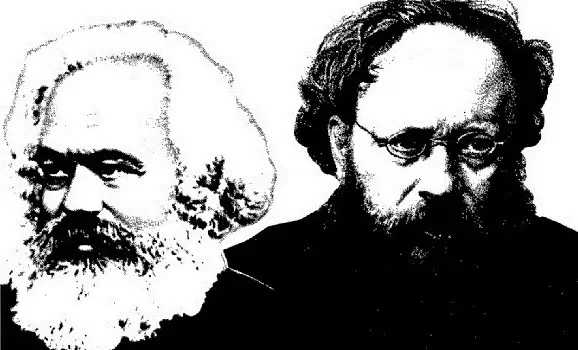
Many know of anarchist theorist Pierre-Joseph Proudhon’s declaration—Property is theft! Few are aware that the man of paradox also declared that “Property is impossible” and “Property is liberty!” Though his ideas have had a significant impact on the history of socialist thought, Proudhon has been reduced to a phrase, his bigotries, and, among Marxists, his supposed refutation by Karl Marx in The Poverty of Philosophy (1847).
It should be uncontroversial to state that Marx simply did not understand Proudhon.1 Few do, or even bother to try, and the difficulty of Proudhon’s writing makes this unsurprising. His style often incorporates paradoxes and provocations, which can be easily misunderstood when taken out of context. As anarchist researchers like Iain McKay and Shawn P. Wilbur have undoubtedly found, it takes significant study to parse Proudhon’s ideas; they cannot be “skimmed through [...] in two days.”2 I can admit that I’ve done enough research to know that I haven’t done enough research on Proudhon’s work to make many definitive characterisations. But Marx’s severe distortion of Proudhon has been elevated beyond merit by the prestige of Marx’s name and over a century of repetition. Despite comprehensive anarchist responses to Marx’s many misrepresentations of Proudhon, the former’s standing among radicals remains unshaken, while the bulk3 of the latter’s work remains untranslated and under-explored.4 In fact, some go as far as to write the relevance of Proudhon’s work out of anarchism altogether.
The rest of this article is not intended to be an anarchist critique of Marx, Engels, or Marxism, nor a comprehensive comparison between the two broad tendencies. Such tasks have already been undertaken by various anarchists past and present—see: Mikhail Bakunin’s Statism and Anarchy (1873), Rudolf Rocker’s Marx and Anarchism (1925), Sam Dolgoff’s The Critique of Marxism (1983), Ronald D. Tabor’s The Tyranny of Theory (2013), Thom Holterman’s Karl Marx: Not Infallible (2014), Lucien van der Walt’s Anarchism and Marxism (2017), William Gillis’ Anti-Engels (or Anti-Anti-Duhring Aktion) (2021), Frank Miroslav’s We Don’t Agree on Capitalism (2024), among others.
Nor is my purpose to parse the utility of Marx’s contributions to the study of wealth accumulation, capitalist crisis, commodity fetishism, alienation, or exploitation.5 Marxist theory is simply not indispensable to my anarchist ends. Although other anarchists find value in the exercise, I am not particularly interested in reconciling anarchism with Marxism. My aim is not to join the chorus of anarchist critics of Marx(ism) nor to attempt to reach Marxists, but rather simply to help fellow students of the Idea begin to understand what differentiates anarchist from Marxist frameworks in order to further our effectiveness as communicators to a largely disaffected populace.
Distinct Visions Of Liberation

Anarchism and Marxism do not begin from the same starting point of analysis. Following their namesake, Marxists view history as shaped by material conditions and class struggle. Capitalism is defined as a “mode of production”—a way of organising economic life and labour—wherein the capitalist class controls the means of production and exploits the labour of the working class by extracting surplus value. The state is instrumentalised, meaning it is seen as a tool wielded by different classes in order to carry out their will. For Marxists, the state is a necessary instrument which must be temporarily seized—typically by the communist party—to organise production and suppress counter-revolution until class divisions dissolve, at which point the state “withers away.”
Anarchists start not with the question of capitalism, but with the question of authority: what it is, where it appears, how it reproduces itself, and how to dismantle it in every sphere. Capitalism only emerged in the past few centuries; authority in various forms has oppressed humanity for millennia. While anarchists oppose the class relations inherent to the capitalist system, our struggle is far-reaching and multi-dimensional. We are not mere anti-capitalists. We oppose every relation and system that places one person or group in a position of authority over another.6 The anarchist project challenges authority and privilege wherever it appears: in the economy, government, and social life. At the same time, anarchists seek to build new forms of association grounded in both individual autonomy and social interdependence.
The shared use of terms like class, state, and revolution conceals our profound theoretical differences. Marxists and anarchists understand the same terms very differently. Marxists see the state as primarily an instrument of class domination to be wielded for revolutionary socialist ends. For anarchists, the state is no mere instrument. Class is understood not solely in terms of relations of production, but also in terms of relations of domination.7 These are fundamentally different frameworks, which inevitably result in divergent strategies. While most Marxists dismiss the question of authority entirely and see utility in seizing the state to resolve class struggle, anarchists recognise that the authority of the state both precedes and institutionalises the particular class dynamics identified under capitalism. Capitalists collaborate with states to maintain an economy that benefits their elite interests, but the state itself represents a “class dynamic” and possesses its own interests. Anarchists refuse to underestimate the state’s antagonistic role in the millennia-long struggle for human freedom. States cannot be captured and redirected for liberatory ends; their hierarchical nature renders them impervious to genuine popular control. They must be dismantled, lest they reproduce the very structures of subordination that our revolution seeks to abolish.
This assumption of a shared understanding of class and the state can lead Marxists and (communist) anarchists to the mistaken conclusion that they have a shared understanding of the end goal—a stateless, classless, moneyless society—and a mere difference in revolutionary strategy.8 But anarchists and Marxists do not necessarily share an end goal or agree on the nature of revolution.
Firstly, the stateless end goal of Marxism is not the statelessness of anarchy. Marxist communism, as described by Engels, retains administrative authority; anarchists reject all authority. And contrary to popular reductions of anarchism to its communist variety, anarchism is far more economically pluralist in its opposition to capitalism and the state. Mutualism, one of the original schools of anarchist thought, is notably open to experimenting with both non-capitalist markets and money in the form of mutual credit.
Secondly, Marxists often frame revolution as a process of social transformation guided by the state. Anarchists instead view revolution as an ongoing process of transforming social relations through prefigurative9 organisation and opposition to hierarchy everywhere. It is the transformation of the totality of life itself, the liberation of all dispossessed and exploited on all scales of society from all relations of domination.
Thus the question of revolutionary organisation is approached differently. Marxist strategies emphasise the primacy of centralised, hierarchical organisation, typically by the vanguard party, in preparation for the seizure of the state. Anarchists look to decentralised and horizontal organisations, formed by free association10, as a means of prefiguring anarchist relations and institutions. While Marxist organisations focus on building their understanding of class consciousness among workers, the “class consciousness” that anarchists aim to build is a distinctly anarchist consciousness which identifies and opposes all relations of domination within society.
In sum, understanding anarchism through Marxist frameworks can obscure what is distinctive about anarchist philosophy. Anarchism(s) and Marxism(s) put forward different visions of freedom and paths toward it. Though it is clearly not impossible to bring these tendencies into conversation, effort must be taken to understand what distinguishes them and to more carefully translate the vocabulary that is often shared yet understood differently between them. By resigning anarchy to Marx’s shadow, we miss the uniqueness of the Idea.
Anarchism need not lean on Marx to stand upright.
All power to all the people.
Peace.
1 Or, less charitably, that he intentionally misrepresented him, but as Hanlon’s Razor recommends, never attribute to malice that which is adequately explained by ignorance.
2 See Iain McKay’s article on Proudhon’s constituted value and the myth of labour notes (2017) for the citation of this quote by Marx on how he read System of Economical Contradictions: Or, the Philosophy of Poverty (1846).
3 Quoting translator and archivist Shawn P. Wilbur’s review of “Property is Theft!”:
“During his lifetime Pierre-Joseph Proudhon published two dozen works, ranging from pamphlets to the six-volume Justice in the Revolution and in the Church. Another fifteen were published posthumously. His published notebooks and correspondence add another seventeen volumes, and his unpublished manuscripts (many of which are now being digitized by the Ville de Besançon) contain several thousand pages of important material. Yet, until recently, all that has been available of Proudhon’s work in English has been four complete volumes (What is Property?, Letter to M. Blanqui, General Idea of the Revolution in the Nineteenth Century, and the debate with French free market economist Frédéric Bastiat, although the last was published serially and has been largely inaccessible), partial translations of four others (The Principle of Federation, System of Economic Contradictions, The Social Revolution Demonstrated by the Coup d’Etat, and Literary Majorats), a few essays, and a collection of short excerpts, drawn rather haphazardly from across Proudhon’s works.”
4 This widespread incuriosity of Proudhon’s actual works, unfiltered by Marxist distortions, extends even to many (communist) anarchists—who take second-hand accounts of the man's ideas at face value and would more readily read Marx’s Das Kapital (1867) than Proudhon’s Theory of Property (1865).
5 I will note, however, that anarchism has had its own theory of exploitation, in line with its broader critique of authority, that precedes and exists independent of Marx.
Marx located exploitation in the extraction of surplus value from labour, while Proudhon identified it in the appropriation of the fruits of collective force—which is the emergent productivity of association—by capitalist and governmental authority.
6 A form of intersectionality can therefore be viewed as intrinsic to anarchism, which has long emphasised a multi‑axis analysis of oppression and domination—even if historical anarchists sometimes fell short in practice.
7 As van der Walt notes:
“The deeper point that should not be lost is that class is partly about relations of production and partly about relations of domination and neither is simply the consequence of the other. These relations are intertwined, although distinct. Private ownership of the means of production can only be used for exploitation if buttressed by relations of domination, whereas monopoly of the means of coercion and administration requires the financing provided by economic exploitation. The state apparatus provides the state managers with an independent resource base that enables their empowerment and enrichment. Economic power allows individuals access to state power, but state power allows individuals access to economic power as well. And, while the political and economic elites wield different resources, their interests are convergent and mutually reinforcing but not identical.”
8 It is often framed as if anarchists—being well-meaning but naive—share the stagist view of revolution and wish to simply skip the “transition state” and usher in communism overnight.
9 Meaning building social relations that reflect the world one hopes to create.
10 Free association refers to the ability of each individual to associate or disassociate with others as they so choose on the basis of their specific interests and goals.