It’s Time To Rethink Religion
This article is an adaptation of a video I originally published on my YouTube channel.
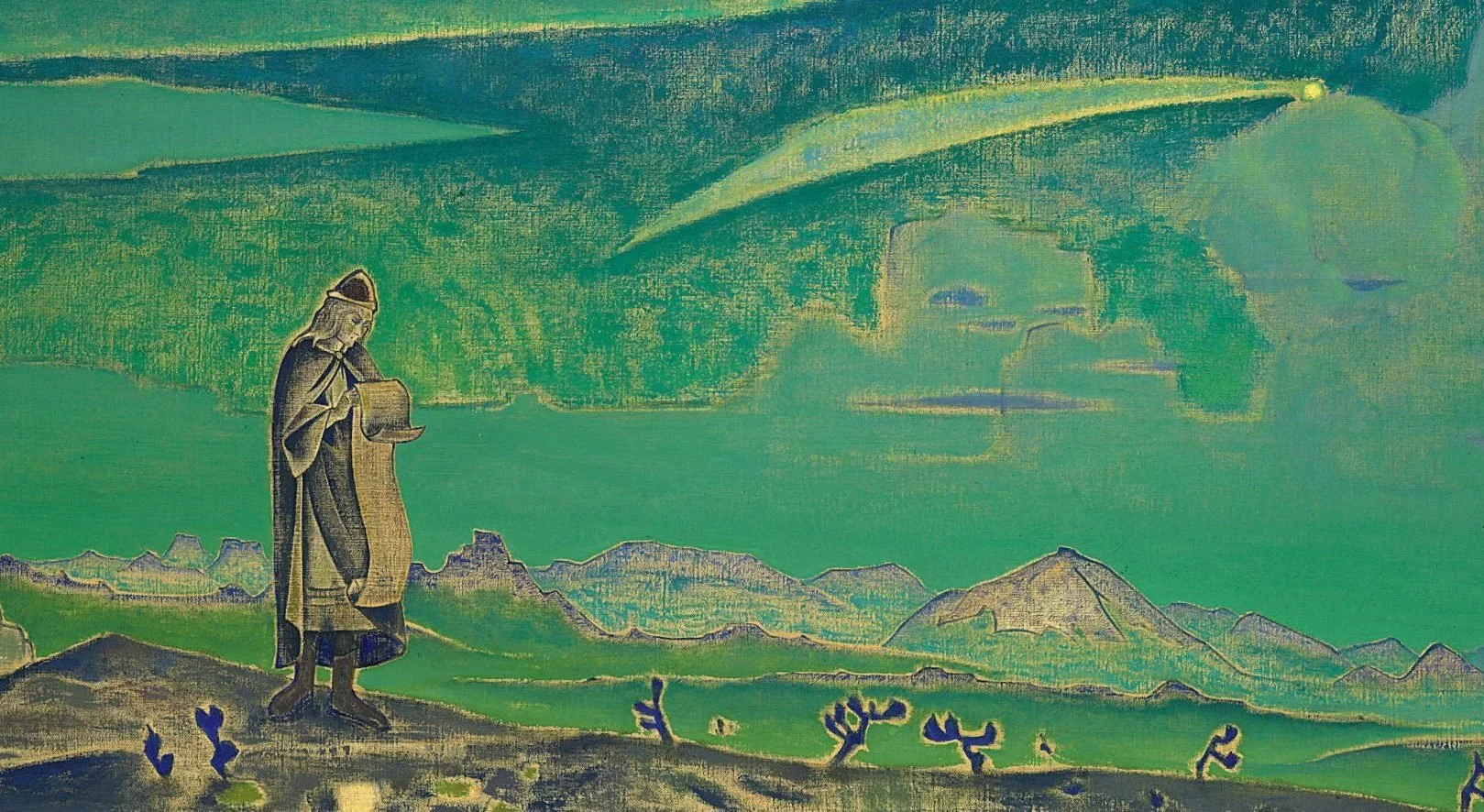
Art by Nicholas Roerich
When I look outside my window, part of me wants to weep at the beauty of the natural world. I have the grand fortune of greeting forested mountains every morning. On most days, the skies yawn before me with brilliant brushstrokes of white amongst the blue. I’m blessed to see all sorts of birds visiting my neighbourhood, from the quarrelsome grackle to the conversational kiskadee. When I behold the brilliance of nature, I can understand the impulse for religion. As the naturalist John Muir wrote:
“In our best times everything turns into religion, all the world seems a church and the mountains altars.”
Religion plays a crucial role in societies across planet Earth, for better and for worse, shaping how people perceive each other, organise politics, and interact with the natural world. Although secularism has gained significant ground over the past century, the persistence of religion, in various forms, cannot be understated. Particularly where religion intersects with capitalism, statism, racial hierarchy, and perhaps most infamously, patriarchy.
But what exactly is “religion” anyway?How has it affected the way we relate to nature and each other? As people fighting for the present and future, what role might religion play in our lives?
Anarchists have long proclaimed “no gods, no masters.” But is there still room for religion in anarchy?Should we start our own “solarpunk religion?”
Questions, questions, questions. And with my limited answers, I have no doubt that we can have a reasonable conversation about one of the least controversial topics in human history. (/s, duh)
What is Religion?
Let’s start by defining religion: there is no uncontested definition of religion. Encyclopaedia Britannica calls it “human beings’ relation to that which they regard as holy, sacred, absolute, spiritual, divine, or worthy of especial reverence.” Wikipedia defines religion as “a range of social-cultural systems, including designated behaviors and practices, ethics, morals, beliefs, worldviews, texts, sanctified places, prophecies, or organizations, that generally relate humanity to supernatural, transcendental, and spiritual elements.”
Religion may involve gods and spirits and guide interactions with human communities and the natural world. Special texts may be upheld as holy and special people may be upheld as authorities. Some religions emphasise right behaviour, others emphasise right belief.
Considering the range of things involved, perhaps you can see why religion is so hard to delineate. It overlaps with much of what makes us human: how we see the world, what we value, and what we do in our day to day lives. That trifecta aligns with author Mark Green’s definition of religion, in Atheopaganism (2019), which we’ll return to later; religion as a combination of cosmology, ideology, and practice.
The cycle of Saṃsāra, the dualistic war between Good and Evil, and the belief in any form of afterlife fall under cosmology: what is believed about the nature of the universe. The values of a religion fall under ideology. These are principles that guide your behaviour, from the golden rule to the Law of Moses, as well as what may be considered sacred or profane. Rituals, prayers, rites, festivals, and so on fall under the practice of religion.
As Green describes, one of the reasons religion persists is thanks to the way humans process and interpret information. Our brains are wired to recognise patterns and log memories. These memories may be of direct sensory experiences or the imagined experiences of dreams, hallucinations, and stories. We use these memories to navigate the world, but our memories are not as reliable as they may seem. Our ability to discern real memories from false memories is pretty weak. Our brains will often emphasise information that reinforces what we already believe and discard the rest, a phenomenon known as confirmation bias. When you add the cultural conditioning of religion, which may normalise the belief in the supernatural through stories, people will “see” support for their beliefs no matter what.
Religion manifests in vastly varied and surprisingly similar ways across continents and cultures. I’m speaking from the perspective of someone with an intimate, lifelong knowledge of Christianity—though I’ve deconstructed—and some familiarity with Islam and Hinduism. That’s just life in Trinidad. But long before Christianity, Islam, or Hinduism ever emerged, there was and remains the diverse set of beliefs, values, and practices held by ancient and contemporary peoples that are now grouped under the anthropological construct of animism.
Animism, The Original Religion?
Modern Homo sapiens have been around for roughly 300,000 years. For most of that history, we’ve had a fairly intimate relationship with the rest of the biosphere. When discussing animism in Less is More (2020, Ch1), anthropologist Jason Hickel pointed out that the same way many of us today can recognise and remember facts about the brands, celebrities, and politicians of our media landscape, early human societies would’ve been able to name and describe “hundreds if not thousands of plants, insects, animals, rivers, mountains and soils.” These humans would’ve understood that their existence depends on the well-being of the biosphere. There’s only so much we can know about their beliefs, since they don’t exactly fossilise. But they may have seen common traits and even kinship with the rest of the living and non-living community, and thus developed moral codes that would guide their interactions with these systems accordingly. This is the way of seeing the world that anthropologists call animism.
In Beyond Nature and Culture (2013), anthropologist Philippe Descola recognises that contrary to our contemporary separation of humans from the rest of nature:
“In many regions of the planet, humans and nonhumans are not conceived as developing in incommunicable worlds or according to quite separate principles. The environment is not regarded objectively as an autonomous sphere. Plants and animals, rivers and rocks, meteors and the seasons do not exist all together in an ontological niche defined by the absence of human beings.”
Animism emerges from and reinforces the mutualistic and commensalistic relationships that humans develop with our fellow organisms. As described by anthropologist Samuel Miller McDonald in Progress (2025, Ch:‘The Vital Science of Human Ecology’), ecology identifies three notable kinds of relationships between organisms: mutualism, commensalism, and parasitism.
In mutualistic relationships, organisms benefit each other. We provide hives and protection, while bees pollinate crops and produce honey. In commensalistic relationships, one organism captures energy from another while doing neither harm nor good to the other. Lots of animals and plants make their home among trees while neither harming nor helping the tree itself. Finally, in parasitic relationships, one organism captures energy from another to the other’s detriment, like the mosquitoes that may suck your blood with deadly consequences. So mutualism co-benefits, commensalism co-exists, and parasitism deprives.
Beyond organism-to-organism relations, McDonald applies this framework to an organism’s relationship with its environment. Human individuals and societies may form mutualistic, commensalistic, or parasitic relationships with the ecological systems they inhabit. And animist societies generally engage in commensalistic and mutualistic relationships with their environments.
For animists, all creatures and things are ensouled—having personhood—from animals to plants to rivers to mountains. In McDonald’s words, “An animistic world is vibrant and full of life, the forest a bustling city of creatures with unique and mysterious minds, a universe populated by millions of interiorities.” As Descola recounts for example, among the horticultural Achuar people of the Amazon, plants and animals are seen as relatives (Ch1). Plants are children that must be mothered to maturity, while animals are the brothers-in-law the men hunt with respect and circumspection.
I can already hear the objection that some of the Indigenous or prehistoric societies that are usually considered animist have also done harm to their environments and even caused extinctions. This is true. When expanding into new territories, many groups did damage the wildlife populations they encountered. Perhaps most infamously, human arrival in North America and Australia coincided with the extinction of several megafauna. McDonald also recounts the Austronesian peoples that decimated native species on many of the Pacific islands they set foot on. But though it came at a profound cost, they eventually learned to stop exploiting those places and developed beliefs and practices that integrated their societies within the limits of the islands’ ecosystems. They would still fish, hunt, gather, and farm, but sustainably, in the spirit of reciprocity and respect.
Which is just a sensible thing to do. Our health and well-being, along with that of countless species, depends on how our human systems materially relate to natural systems. Animist beliefs thus provide a useful society-wide guide for beneficial behaviour.
And yet, animism is not the widespread belief of our times. How did we end up here? Animism was displaced in much of the world. And now our societies are not primarily mutualistic or commensalistic in relation to the rest of nature. Our material relation with the biosphere is primarily parasitic.
The Rise of States (and Dualism)
This is thanks, in part, to the catastrophic rise of states and development of dualism. Just to be clear, what follows isn’t an exhaustive history of every religion and state, but an incomplete overview of where some of the dominant worldviews we inherited came from.
In Worshiping Power (2017, Ch11), anarchist Peter Gelderloos highlights how early states relied on religious and ritual authority to consolidate control. Early hierarchical religions were born among certain sedentary agricultural communities to legitimise authority, patriarchy, and state formation. While stateless peoples, whether mobile or sedentary, retained their decentralised animisms, heterodoxies, localised deities, and non-hierarchical pantheons, statist religions went in the opposite direction.
From Mesopotamia to the Andes, religion became centralised at monuments, pyramids, and temples which attracted followers and coalesced a professionalised priestly class, and in some cases, priest-kings. Divine symbols and rituals were created around these sites to solidify their authority. Writing and number systems were used to support state administration, commercial record-keeping, and symbolic architecture. They elevated certain deities as supreme above the others while elevating certain human rulers as supreme above lesser rulers. Maternal, genderless, or hermaphroditic Earth Mothers and Great Spirits were replaced with Father Gods in the spiritual order just as men were elevated above women in the social order. Spiritual, political, and commercial power went hand in hand.
Statist societies fomented the erosion of animist beliefs and in many places favoured dualistic beliefs. Dualism can mean many different things, but I want to focus on the mind-body dualism and human-nature dualism that has come to dominate our vision of reality. Historian Carolyn Merchant argues in The Death of Nature (1980, Ch1) that for a long time, animist ideas curtailed people’s behaviour towards the Earth:
“The image of the earth as a living organism and nurturing mother had served as a cultural constraint restricting the actions of human beings. One does not readily slay a mother, dig into her entrails for gold or mutilate her body […] As long as the earth was considered to be alive and sensitive, it could be considered a breach of human ethical behaviour to carry out destructive acts against it.”
As Hickel notes, this doesn’t mean that people didn’t extract from the land or mine the mountains, but that they did so with decorum, limiting how much they took and treating it as one might treat a gift. But the religions of kingdoms and empires split the world in two, with a spiritual realm of god(s) separate from and above the material realm, and with humans privileged to rule in that realm. This is human-nature dualism, and in stark contrast to animist beliefs, it is the idea that humans are elevated above the rest of the living world. This notion is most apparent in the Abrahamic religions, where humans are made in the image of God and given stewardship over creation. This idea later served capitalism, which arose in Christian Europe, as it bolstered the belief that the earth could be considered a stock of natural resources for humans to parasitically exploit. Although dualistic ideas have existed in various forms elsewhere, the dualism that reshaped the globe is largely rooted in Abrahamic and especially European Christian intellectual traditions.
This idea was not strictly religious. Today considered one of the founders of the scientific method, 16th-century philosopher Francis Bacon pushed a worldview that recast nature as something mechanistic, unruly, and feminine, something to be subdued by man’s science. But the 17th-century philosopher René Descartes was the figure responsible for the full fledged formulation of this nature-as-object philosophy, as identified by Hickel in Less is More (2020, Ch1).
Perhaps best known for his line, “I think, therefore I am,” Descartes argued for a strict separation between mind and matter. This was the foundation of mind-body dualism. Humans alone were said to possess both minds (or souls) and bodies due to our connection to God. All other creatures were mere matter: automatons, with no mind, spirit, or agency of any kind. So when Descartes was dissecting live animals, including his wife’s dog, he could dismiss their cries as simple reflex.
Descartes’ dualism directly contradicted the animist belief in the continuity between humans and other beings. Humans became the only subjects, and nature was reduced to objects. This shift helped justify the enclosure of common land. Enclosure, in turn, helped people internalise the dualist view by cutting them off from the living world. Nature became property to be owned and extracted for human ends. As 18th-century philosopher Immanuel Kant wrote, “As far as non-humans are concerned, we have no direct duties. They are there merely as the means to an end. The end is man.”
And speaking of man, dualism could be used to justify the extraction of women’s domestic labour, as they were cast as “closer to nature.” African and Indigenous peoples were also cast as part of nature—objects rather than subjects—which legitimised the enslavement, dispossession, and exploitation that defined the age of colonialism. As part of their so-called “civilising mission,” colonisers sought to eradicate animist beliefs in colonised populations. Dualism would be instilled as the mental foundation for capitalist expansion. In DecolonisingtheMind (1986, Ch1), author Ngũgĩ wa Thiong’o noted: “[Colonialism’s] most important area of domination was the mental universe of the colonised, the control, through culture, of how people perceived themselves and their relationship to the world.”
Before industrial capitalism, peasant life was marked by seasonal rhythms, community festivals, and slow-paced work. But European elites demanded a more disciplined workforce. If Descartes’ dualism meant that the body could be treated as mere machinery, then it could be re-engineered for compliance and productivity. Grinding centuries of industrial labour and cultural conditioning would thus produce the ideal worker of today, one who is expected to suppress pleasure, spontaneity, and autonomy for the sake of production.
And now, as Hickel observes, “We are all heirs of dualist ontology. We can see it everywhere in the language we use about nature today. We routinely describe the living world as ‘natural resources’, as ‘raw materials’, [...] Dualism runs so deep that it wriggles into our language even when we’re trying to be more conscientious. The very notion of ‘the environment’ [...] presupposes that the living world is nothing more than a passive container, a backdrop against which the human story plays out.”
These are thought patterns I’m still trying to unlearn. The fall of animism and rise of dualism has coincided with our separation from our ecological kin, a wound it will take time and effort to repair.
My Problems with Religion
But the problem of dualism is not my only issue with religion; and although my critique centres on the mainstream Abrahamic faiths, especially Christianity, many of the concerns I’m about to discuss appear in other religions as well, though I know they may not appear in all. I’m speaking of the religious tendencies toward authority and superstition.
As an anarchist, I’m opposed to all hierarchies and authorities—along with their “justifying” dogmas. That includes religious dogmas. I don’t care for any system that privileges some individuals, groups, or institutions over others. That includes priests, churches, and temples, as well as certain “castes” or “races.” I don’t believe in anyone having a right above others to command obedience and control resources. That includes supposedly God-ordained kings, slave masters, patriarchs, and capitalists. These concepts of hierarchy and authority are baked into so many of the religions at the centre of people’s lives today. The word hierarchy is literally derived from religion. People reference celestial and ecclesiastical hierarchies as justifications for hierarchy being the “natural order of things.” Deference to authority often leads to accepting the unscientific or prejudiced views held by leaders or texts without scrutiny. I saw it all the time in the church I used to go to. And religion bears significant responsibility for the dominance of patriarchy over women and children around the world.
But in my subjective experience, it has become a taboo among some anarchists to speak openly about this. Out of a genuinely noble desire to respect others and a sensitivity to the history of religious prejudice and persecution, some anarchists have gone completely silent on the subject. But for as long as there are religions that uphold these oppressive systems, there must be those brave enough to confront them directly. Ideas are not beyond reproach just because they’re religious.
I know that there have always been religious anarchists. I’m aware of the Christian, Muslim, and Jewish anarchists. But the existence of those well-meaning yet marginal strains does not erase ongoing centuries of scriptural and actual authoritarianism. Now don’t get me wrong: I may not see eye to eye with the religious anarchisms, but I don’t have an issue with them as long as they’re truly committed to the struggle against authority. However, Zionism, Jihadism, and Christian nationalism are not going to be defeated by pointing to a few charitable or liberatory scriptures as the “real” interpretation of the religion. These are movements which further fuse the existing connections between religion and politics. They should not be treated as solely religious or used as justification for dehumanisation, but a strictly political analysis is incomplete.
Beyond authority and its consequences, there’s another problem I see in many—though not all—religions: the way they cultivate superstition, which I find seriously harmful. Seeing supernatural explanations for everyday occurrences is not harmless. Strong commitment to belief in unprovable claims regarding gods, spirits, or angels can have an impact beyond one’s personal religious practice. It can reinforce harmful cognitive biases and compel motivated reasoning, making people more likely to accept other claims that fit their religious-political identity and more resistant to correction. It becomes easier to absorb partisan misinformation and dismiss the science around public health emergencies and climate change in favour of divine destinies, spiritual warfare, or an imminent end of the world. For some of the religious people I know, all of this mess in the world was prophesied anyway so there’s nothing to be done. In some cases, religious identitycan overridescientific literacy,even among the highly educated.
I’m against superstition because I believe in seeking “the truth,” even when it’s uncomfortable, and even if it means that I can’t find comfort in confident claims about the unknowable and not yet known. There was a time during my deconstruction from Christianity when I wanted to get involved with pre-Christian African spirituality, particularly the Orisha. I wanted to decolonise my mind and connect with the practices of my ancestors. But while there is a lot to appreciate about Ìṣẹ̀ṣe—I love learning about its cosmology—I can’t make myself believe something just because I think it would be cool if it was true. The same goes for other animist beliefs. While I may appreciate some of their values and practices, I can’t adopt their cosmology as truth.
And yet, despite the problems I see in so many religions, I still understand the appeal. Religion meets social and psychological needs that the scientific method can never meet, like a sense of safety, belonging, meaning, and self-expression. Religion gives people ways to deal with the problems in their lives, like grief and adversity. According to Pew Research, in many countries actively religious people are more likely than their less-religious peers to describe themselves as “very happy.” This doesn’t mean that the irreligious are incapable of happiness and can’tfind things like belonging and meaning outside of religion, but there’s reason to believe that religion is a useful tool for filling the gaps in people’s needs—especially in our increasingly alienated world.
Should We Start A New Religion?
So what is to be done for people like me who cannot accept a supernatural cosmology, but still see value in some of the principles and practices of religion? Can there be a religion without gods, spirits, or any other supernatural cosmology?
For the latter question, the answer is a resounding yes.
Religious humanism is one such approach that integrates humanist philosophy with the rites and activities typical of religion. Among Unitarian Universalists you can find atheists that embrace a “deeds, not creeds” approach to religion focused on furthering social good. But my interest in this topic was reignited by the work of Mark Green. As he has argued, there can be a religion beyond gods that brings it into alignment with science while satiating the deep human yearnings that science cannot. It is possible to “drain the bathwater from around the baby”, as he says in the foreword to Godless Paganism (2016): to feed both heart and head.
Remember his definition of religion? It’s a combination of cosmology, ideology, and practice. What is believed about the nature of the universe, what are the principles that guide behaviour, and what are the activities that define the religion. Green’s proposal is a form of religious naturalism that he calls Atheopaganism. Let’s take a look.
Atheopaganism

The Symbol of Atheopaganism
Since Atheopaganism is a naturalistic religious path, its cosmology is a basic scientific understanding of the Universe, which evolves as we gain new knowledge through scientific discovery and analysis. Atheopaganism treats the natural world as all that exists, so there’s no afterlife, beforelife, reincarnation, souls, or supernatural entities of any kind.
There are Four Pillars within Atheopaganism: Life, Beauty, Truth, and Love.
Life and the systems which support it are sacred and must be protected.
Beauty, which inspires joy and reflects creativity, is sacred and must be cultivated.
Truth, which is necessary to acknowledge harms and right wrongs, is sacred and must be sustained.
Love, which can drive our kindest impulses and uplift us in the darkness, is sacred and must be nurtured.
Atheopaganism also has thirteen principles, but I’ve grouped them into three simple ideas: knowing, relating, and doing.
First: knowing, through scepticism, curiosity, and perspective. Myths and profound experiences can inspire us without literally being true. The metaphorical is not literal. The subjective is not objective. Knowledge is never finished, both of the world and other people. And sometimes the wisest response to the absurdity of life—including ourselves—is laughter.
Second: relating. We practice reverence for the Earth. Humility reminds us who we are in the context of humanity and the universe. We may have special knowledge, talents, or skills, but that doesn’t make us better than anyone else. And in the grand scheme of things, we are temporary specks in the light of the Cosmos. So we treat each other with inclusiveness and compassion, actively counteracting the human urge to Other those who are not like us. Not every opinion should be treated equally, but every person should be treated as an equal. And we act with legacy in mind, knowing our choices become the inheritance of future generations.
Finally: doing. We begin with gratitude as a skill we practice by noticing and appreciating what enriches our lives. With freedom comes responsibility to others, human and non-human. And freedom brings pleasure, which is good only when it causes no harm, respecting safety, consent, and mutual agreement. We carry ourselves with integrity, being honest about our mistakes and true to our word. And of course, there’s the praxis principle: planting gardens, gathering in community, engaging in ritual, and creating art.
So we’ve gone over the cosmology and ideology of Atheopaganism. What remains is its practice. This includes rituals, rites of passage, and yearly observances.
Ritual is an important part of the human experience. It’s a way of processing important moments in our lives, experiencing interconnectedness, and living a more enriched life. Individually, rituals can put us in a “ritual state,” marked by intense present-moment focus, heightened sensory awareness, reduced self-consciousness, and strong feelings of enjoyment and capability. But rituals can also offer the valuable experience of collective effervescence, the feeling of unity and joy that arises when people come together with common purpose; a feeling found in concerts, sporting events, and worship services alike.
Creating an effective ritual is much like cooking. There is a science and an art to it, a framework and a fluidity. The ingredients of an effective ritual are symbolic actions, meaningful objects, and a clear structure and theme. Atheopaganism (2019) offers guidance, but the specifics are really up to you—you can create your own rituals. Ritual is grounded through sensory elements—like candlelight, music, or scent—that reinforce bodily awareness, immersion in the physical world, and appreciation for aesthetic beauty. Ritual works best when it sincerely engages the whole person, through movement, dance, drumming, singing, chanting and tactile experiences. Such experiences can achieve collective entrainment: an almost magical group experience of physical and emotional synchronicity through rhythm and repetition.
In addition to more frequent group and solo practices, Atheopaganism suggests rituals for birth, coming of age, gender transition, graduation, moving, marriage, childbirth, divorce, elderhood, and death, depending on what’s relevant to your life. Many of these are beginnings and endings which rituals can help us process.
For yearly observances, Atheopaganism is oriented around the seasons. For those of us living in the tropics, the four seasons are not quite as relevant, but there’s room to adapt based on your biosphere. Atheopagan observances include the warm communal gatherings for Winter Solstice; celebrations of rain and preparation for the future for Riverain; sowing the gardens and celebrating playfulness for High Spring/Vernal Equinox; celebrating love and fertility for May Day; celebrating the longest day of the year for Summer Solstice; partaking in handicraft and physical work for Summer’s End; enjoying the bounty of the Earth and of labour for Harvest/Autumnal Equinox; and honouring the elderly, the ancestors, and the dead for Hallows.
I don’t currently have rituals like these in my life. But it’s beautiful to think about how I might texture the year with more rites and observances in my calendar. And if this resonates with you, you don’t need to adopt a whole new religion. You could start much smaller by creating a moment of ritual around something that already matters to you.
Last thing to note, there is no room for hierarchy in Atheopagan practices. People may take on coordinating roles when the situation calls for it, but no one is elevated above another. There is no structure that enables abuse and protects abusers. No priests or priestesses. No gods, no masters. In the words of Green himself, “Just we critters, equal and humble under the gaze of the Sun, working together to make our way.”
Conclusion
In my view, Atheopaganism has a compelling combination of cosmology, ideology, and practice. I’m not at the point of calling myself Atheopagan or considering myself religious, but it’s something that I continue to reflect on in the context I find myself in. I exist in a “post”-colonial reality that is still defined by racial and religious division, statist oppression, patriarchal conditioning, and capitalist and imperialist exploitation. I see the climate catastrophe unfolding and the system in polycrisis.
Perhaps these times call for a new animism, one that recognises the interdependence of all life on Earth without compromising a scientific cosmology. A value system that will uproot the colonial dualistic thinking that has thing-ified the Earth—as Aimé Césaire observed—and made it ripe for exploitation. Humanity must reunite with the rest of the community of life, through the practice of reciprocity, and discontinue the systems that see ourselves as separate from it. The authoritarianism and superstition of past religions may be supplanted by new paths, Atheopagan and otherwise, that embrace the values we hold dear and fulfil our yearnings for community.
A new religion is not going to solve all the problems in the world. It may flavour a solarpunk worldbuilding with its values and rituals. It may even inspire individuals to gather and organise in a compatibly anarchist fashion. But I don’t mean to suggest that we treat the plane of religion as the be all and end all. Religion is just one dimension of a multidimensional struggle. We cannot ignore the material conditions alongside the spiritual convictions that bind people to their faiths.
Still, even as an intellectual exercise, this article has helped me to process my thoughts in a way that has given me greater clarity in how I understand and engage with the world. I hope it’s done similarly for you.
Whatever you believe, beliefs matter. They continue to shape our struggle for freedom in the 21st century. The path you choose is up to you.
All power to all the people.
Peace.